CN
CN EN
EN
 jp
jp  th
th 


Email
marketing@valueapex.com


Demo
What are you looking for?
The massive amounts of data generated by modern equipment management systems are like an untapped gold mine if presented only in tabular form. Visual analysis technology transforms this data into intuitive charts, graphs, and dashboards, allowing managers to see the complete operational picture immediately, quickly identify issues, and discern trends, truly making data the "navigator" for decision-making.
1. Real-Time Operational Monitoring Dashboard
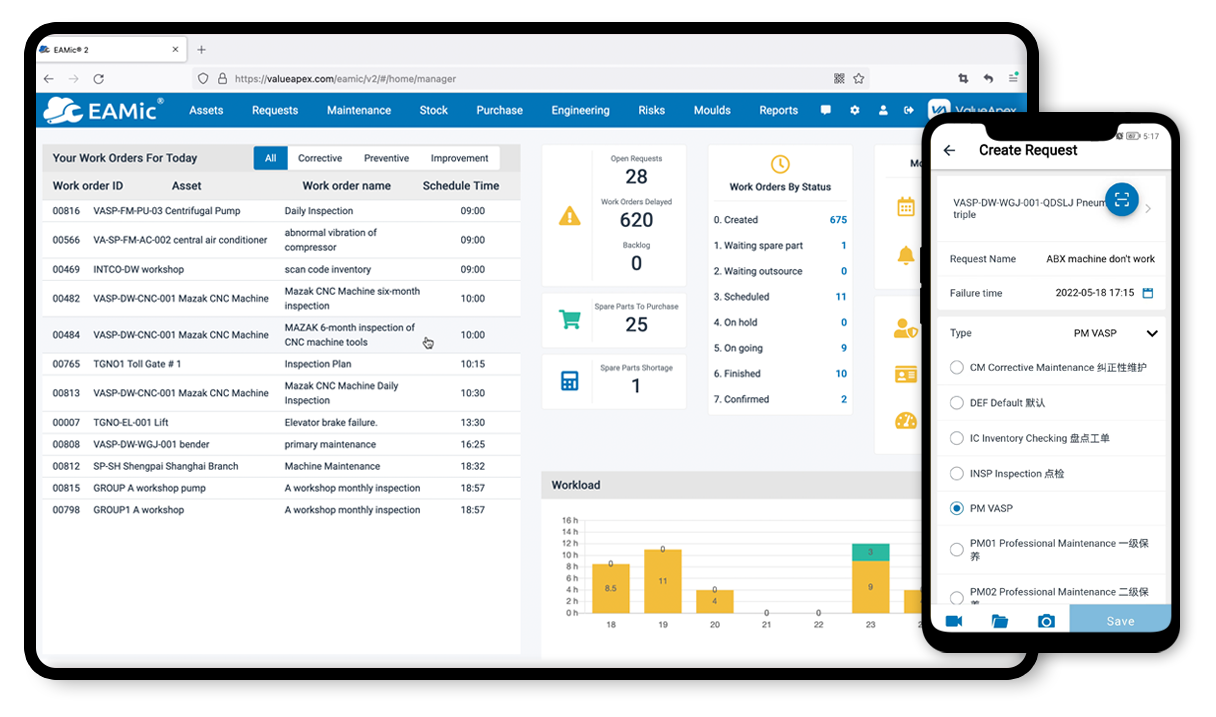
Content: Centrally displays the most critical real-time metrics, such as: a list of currently down equipment and reasons, status of ongoing work orders, planned vs. actual completion, real-time status of critical equipment.
Value: Acts as the factory's "command center," giving managers a clear view of what is happening now for rapid response to anomalies.
2. Performance Indicator Dashboards
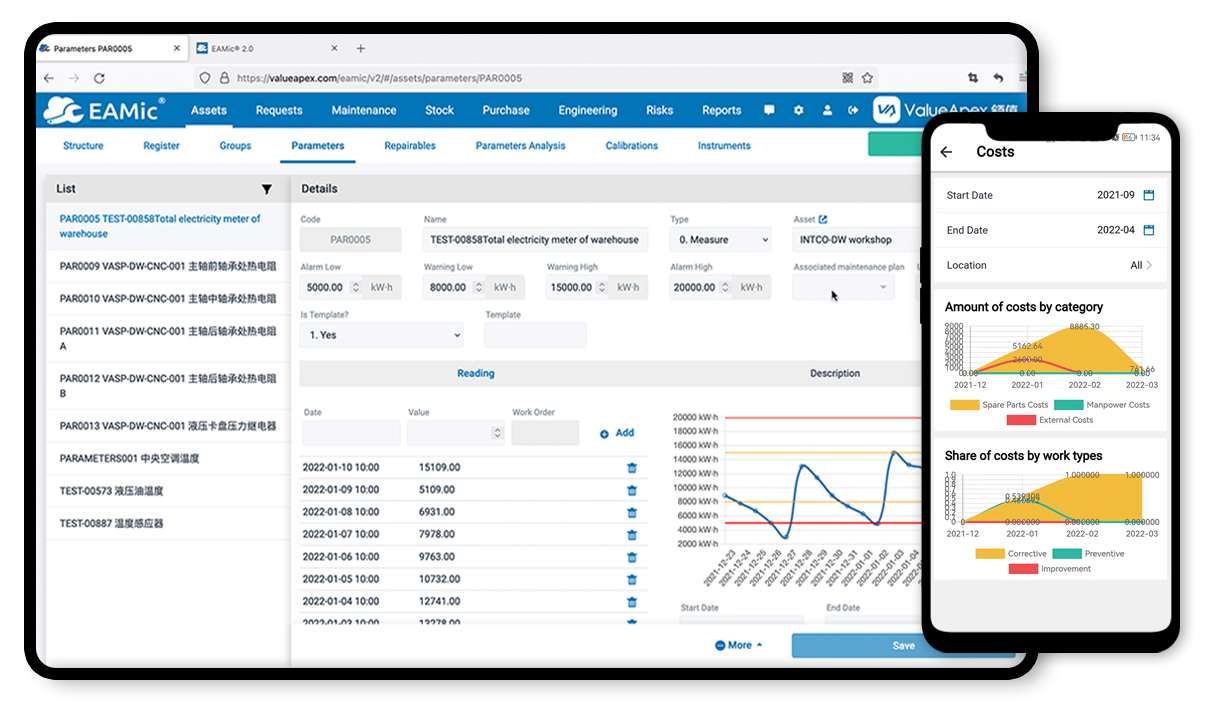
Content: Tracks core KPIs using trend charts, gauges, radar charts, etc., such as: Overall Equipment Effectiveness (OEE) and its three components, Mean Time To Repair (MTTR), Mean Time Between Failures (MTBF), Planned Maintenance Ratio, Maintenance Cost Percentage, Inventory Turnover Ratio.
Value: Quantitatively assesses maintenance team performance and equipment reliability, revealing long-term improvement directions.
3. Work Order Analysis Visualization
Content: Uses Sankey diagrams to show work order priority distribution and status flow; bar charts to rank work order counts by equipment or failure type; scatter plots to analyze differences between actual and estimated completion times.
Value: Identifies bottlenecks in work order backlogs, equipment with high failure rates, and estimation inaccuracies, optimizing the work order management process.
4. Inventory Analysis Visualization
Content: ABC analysis pie charts, inventory value trend charts, obsolete inventory warning lists, top N spare parts consumption charts.
Value: Provides a clear view of capital tied up, quickly identifies obsolete items needing action, and optimizes procurement strategies.
5. Root Cause Analysis Visualization
Content: Uses Pareto charts to identify the vital few failure causes leading to most downtime; uses fishbone diagrams for cause-and-effect analysis.
Value: Focuses efforts on key problems, guides teams in effective root cause analysis, and eliminates repeat failures at the source.

Simplifies Complexity: Presents complex data relationships in the most intuitive way, lowering the barrier to understanding data.
Instant Insights: Discovers patterns and anomalies in seconds that might take hours to analyze from spreadsheets.
Drives Action: Clear charts themselves serve as a call to action, prompting teams to focus on problems and take measures.
Facilitates Communication: Provides a common "language," enabling different departments to communicate and make decisions efficiently based on the same facts.
The visual analysis capabilities of an equipment management system are the key interface for delivering data value to business users. It goes beyond traditional reporting, using interactive, graphical methods to grant enterprises the ability to "see" the future and "foresee" problems. It is the bridge connecting data collection and intelligent decision-making, an indispensable core capability for achieving intelligent operations.