CN
CN EN
EN
 jp
jp  th
th 


Email
marketing@valueapex.com


Demo
What are you looking for?
In today's industrial environment, which pursues efficiency, transparency, and intelligence, the Equipment Management System (EMS) has become an indispensable core information system for enterprises. It acts as the "digital nervous system" of a company, perceiving, monitoring, and managing every key asset on the production floor in real-time. To understand the powerful functionality of an EMS, one must first delve into its core framework. A robust, flexible, and scalable framework is a prerequisite for the successful implementation of an EMS.
A mature Equipment Management System typically adopts a layered, modular design philosophy, and its framework can be divided into four key layers: the Data Acquisition Layer, the Data Transmission Layer, the Platform Service Layer, and the Application Presentation Layer.
This is the bottom layer where the EMS interacts with the physical world and the starting point for all data flows. Its primary task is to acquire various types of data from field equipment accurately and in real-time. The acquisition methods are diverse:
PLC/DCS Interfaces: For highly automated CNC equipment and production lines, standard industrial communication protocols like OPC UA, Modbus, and Profibus are used to communicate directly with the equipment controller, obtaining core data such as equipment operating status, process parameters, and production counts.
Sensors and IoT Modules: For non-smart or work order management, intelligent sensors for vibration, temperature, and energy consumption are installed, converting physical signals into digital signals, which are then aggregated and uploaded via IoT gateways.
Manual Entry and Barcode/RFID: For information requiring manual intervention, such as equipment inspection, repair records, and spare part replacements, mobile terminal apps are used to scan QR codes or RFID tags for fast, paperless entry.
This layer is responsible for securely and reliably transmitting the raw data acquired by the acquisition layer to the cloud or an on-premises data center. With the development of the Industrial Internet, technologies in this layer are continuously evolving:
Industrial Gateways: These play a key role in protocol conversion and data preprocessing. They can unify a variety of industrial protocols into standard protocols like MQTT and HTTP, and possess edge computing capabilities to perform data filtering, caching, and preliminary analysis locally, reducing the burden on the cloud.
Network Channels: Depending on site conditions, wired industrial Ethernet, wireless Wi-Fi, 4G/5G, or even low-power wide-area network technologies like LoRa can be used to ensure stable data transmission in complex industrial environments.
This is the core of the EMS, carrying all business logic and data processing capabilities. It is usually built on a cloud platform or powerful servers and includes the following key service modules:
Equipment Modeling and Digital Twin: Creates a corresponding "digital twin" model in the digital space for each physical asset, defining its attributes, status, relationships, and behavior. This is the cornerstone for achieving refined management.
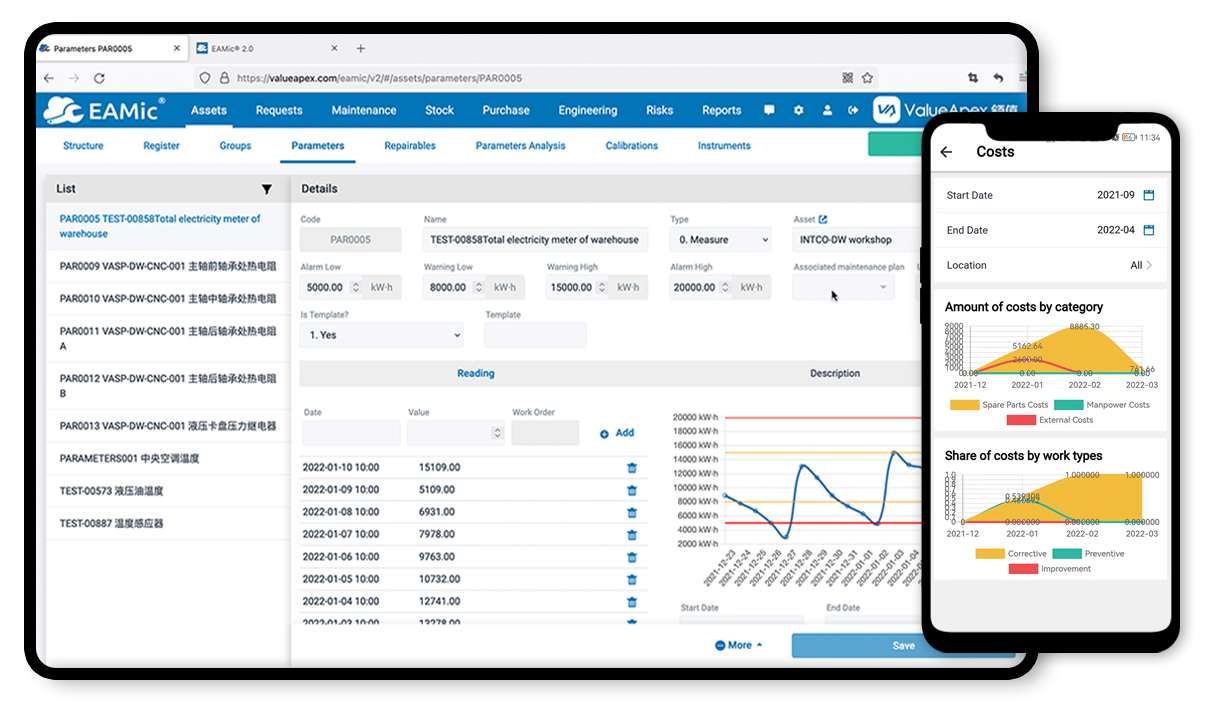
Data Storage and Processing Engine: Uses time-series databases to efficiently store massive amounts of equipment operating parameters, combined with relational databases to store structured data like equipment files and work orders. Utilizes big data processing frameworks for in-depth data analysis.
Analysis and Decision Engine: This is the embodiment of intelligence. Through built-in algorithm models, it performs failure prediction and health management by analyzing trend data like vibration and temperature, providing early warnings for potential faults. Simultaneously, it conducts energy efficiency analysis and OEE calculations, providing data support for management decisions.
Rules and Workflow Engine: Allows enterprises to define custom business rules. For example, if equipment temperature exceeds a threshold for five consecutive minutes, it can automatically trigger a "maintenance work order" and push it to the designated maintenance engineer.
This is the part users interact with directly, presenting the powerful capabilities of the platform layer in an intuitive and easy-to-use form.
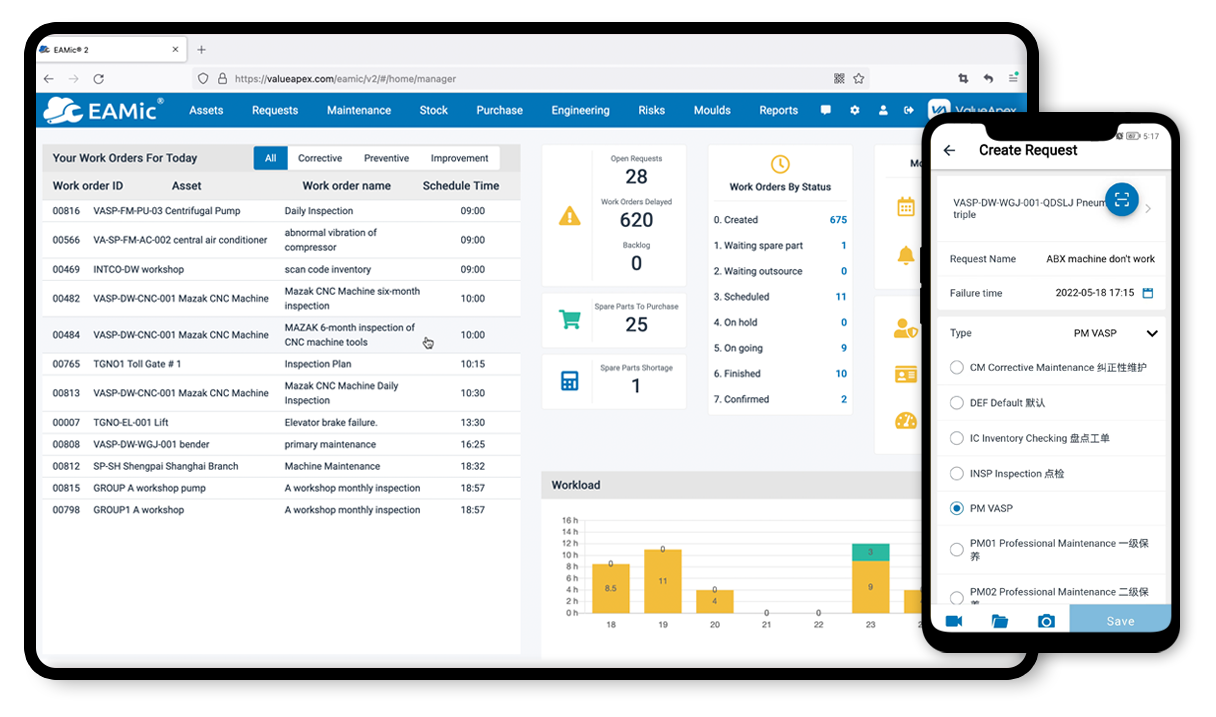
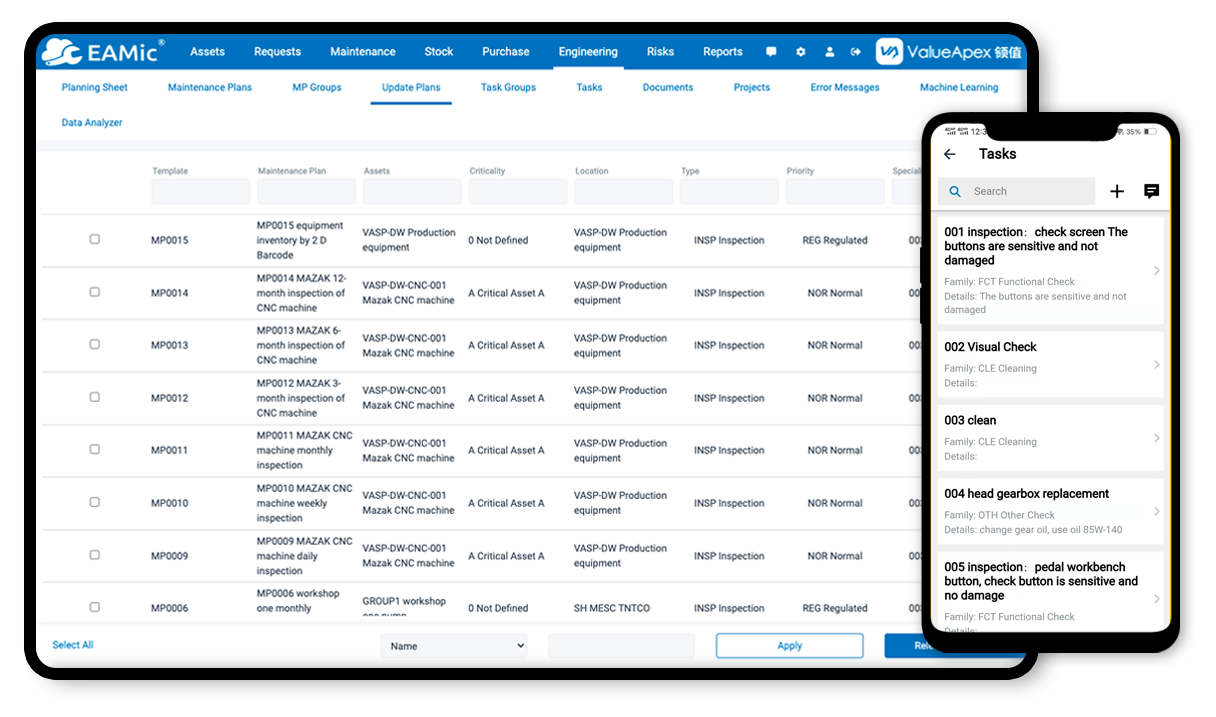
Web Management Console: Provides comprehensive functional operations for equipment administrators and maintenance managers, including equipment file management, maintenance schedule planning, work order dispatch and tracking, and spare parts inventory management.
Mobile APP: Provides convenient tools for field engineers, allowing them to receive work orders, scan equipment QR codes, record maintenance processes, and request spare parts, enabling mobile operations.
Visualization Dashboard: For management, it centrally displays key enterprise equipment overview status, OEE, downtime rankings, maintenance costs, and other core indicators through rich charts, gauges, and Kanban, achieving a "single-screen overview."
An excellent Equipment Management System framework is not just about technology stacking but also involves thoughtful consideration of the synergy between layers, smooth data flow, and future scalability. Starting from the underlying IoT perception, it uses stable network transmission to perform intelligent analysis and decision-making in a powerful platform center, and finally meets the needs of different roles through diverse applications. Thereby, it builds a solid, intelligent digital foundation for equipment management, driving the continuous optimization and upgrading of production operations.