CN
CN EN
EN
 jp
jp  th
th 


Email
marketing@valueapex.com


Demo
What are you looking for?
Device connectivity is the lifeblood of all functions of an Equipment Management System (EMS). Without accurate and comprehensive device data access, subsequent monitoring, analysis, and optimization are impossible. Therefore, how to efficiently and standardized "invite" diverse physical devices into the digital management system is the primary challenge when implementing an EMS. This article will delve into the entire process and core technologies of EMS device connectivity management.
Logical preparation is crucial before starting wiring and configuration.
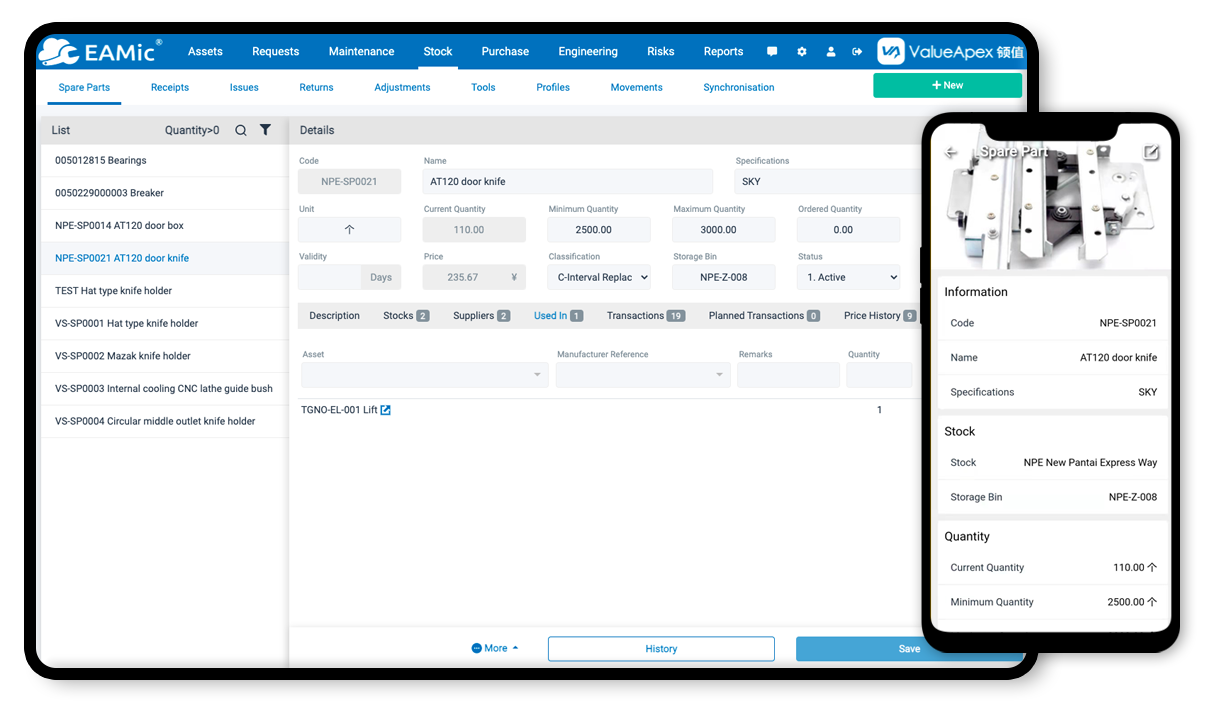
Establish Equipment Files: Create a unique digital identity (ID) for each device in the system and enter basic information such as equipment name, model, specifications, supplier, serial number, production line, and location. This is the "household register" of the device in the system.
Define Data Point Tables: This is the core technical document for connectivity. It is necessary to define which data needs to be collected for each device, for example: operating status, current, voltage, speed, production output, alarm codes, etc. Each data point needs to be defined with its name, identifier, data type, unit, and data source address.
This is the process of physically connecting devices to the network, and the method varies depending on the level of automation of the device.
This is the ideal scenario. Modern CNC machine tools, robots, AGVs, etc., usually come with PLCs or controllers and support standard industrial communication protocols. The EMS connects to them in the following ways:
Direct Connection Collection: Through an industrial gateway, it communicates directly with the device's controller. The gateway acts as a "translator," converting the proprietary or standard protocols used by the device into universal protocols that the EMS platform can understand.
OPC UA Architecture: OPC UA has become the de facto standard for industrial interoperability. The device controller acts as an OPC UA server, providing a standardized data interface, and the EMS platform acts as an OPC UA client to subscribe to and read data. This method offers good cross-platform compatibility and high security.
Many existing devices may lack Ethernet interfaces, offering only simple I/O points or no data output capability at all. These devices need to be "empowered":
Install Sensors and IoT Modules: Install vibration sensors, temperature sensors, power meters, etc., on key parts of the equipment. These connect to IoT acquisition modules via 4-20mA current signals or I/O signals. The module digitizes the analog signals and sends the data to the cloud via Wi-Fi or 4G/5G networks.
Pulse Signal Collection: For production counting, pulse signals from photoelectric switches or encoders can be collected to indirectly obtain data.
For non-powered equipment like handcarts and tool cabinets, the management focus is on their location, status, and availability. By attaching QR codes or UHF RFID tags and having employees scan them with mobile apps, information such as usage records, inspections, and repair requests can be recorded.
Raw data collected directly from devices is often rough and noisy. Industrial gateways perform preliminary processing before transmission:
Data Cleansing: Filters out obvious outliers and invalid data.
Data Caching: Locally caches data when the network is interrupted and resumes transmission from the breakpoint after the network recovers, ensuring no data loss.
Edge Computing: Performs preliminary calculations at the data source, for example, calculating OEE, determining equipment status, and performing simple threshold alarms. This greatly reduces the burden on the cloud platform and enables faster local response.
When the device data stream stably reaches the EMS platform, the system needs to complete the final "registration" process:
Device Activation and Binding: Binds the physical device uploading data with the pre-created equipment file in the system. At this point, the physical device is successfully associated with its digital twin.
Status Monitoring and Diagnosis: The system begins to continuously receive device data, updating the status of its digital twin in real-time. Administrators can see in the system whether the device is online, if data transmission is normal, and can diagnose connection faults.
The device connectivity management of an Equipment Management System is by no means simple "plugging in" work; it is a combination of standardedly modeling, diverse physical connections, intelligent edge processing, and platform-side lifecycle management. It requires the implementation team to understand both IT technology and operational technology (OT) environments, enabling them to develop the most suitable connectivity solution based on the enterprise's equipment status, thereby ensuring the accuracy, stability, and real-time nature of the data flow, laying the strongest foundation for the value realization of upper-layer applications.