CN
CN EN
EN
 jp
jp  th
th 


Email
marketing@valueapex.com


Demo
What are you looking for?
In the grand picture of a Manufacturing Execution System (MES), the equipment management module is by no means an isolated function but a core hub closely connecting production planning, quality management, and material flow. It ensures that production orders can be executed efficiently and accurately at the equipment level, while simultaneously feeding the status and performance of the equipment back to the planning layer, forming a complete "plan-execute-feedback" closed loop. This article will provide an in-depth analysis of the core functions and value of the equipment management module within an MES.
Modern factory production activities revolve around equipment. The core goal of MES is to optimize the manufacturing process, and the premise for all this is that the equipment is "obedient, healthy, and efficient." The equipment management module ensures that the MES system can:
Answer "What can be produced?":Based on the real-time status and health of equipment, it provides capacity basis for advanced production scheduling.
Guarantee "Production According to Plan”: Reduces unplanned downtime through preventive maintenance, ensuring production orders are completed on time.
Know "How is the Production Going?”: Quantifies production efficiency by automatically calculating core indicators like OEE through collected equipment data.
The equipment management module in an MES typically includes the following core functions:
1. Equipment Files and Full Lifecycle Management
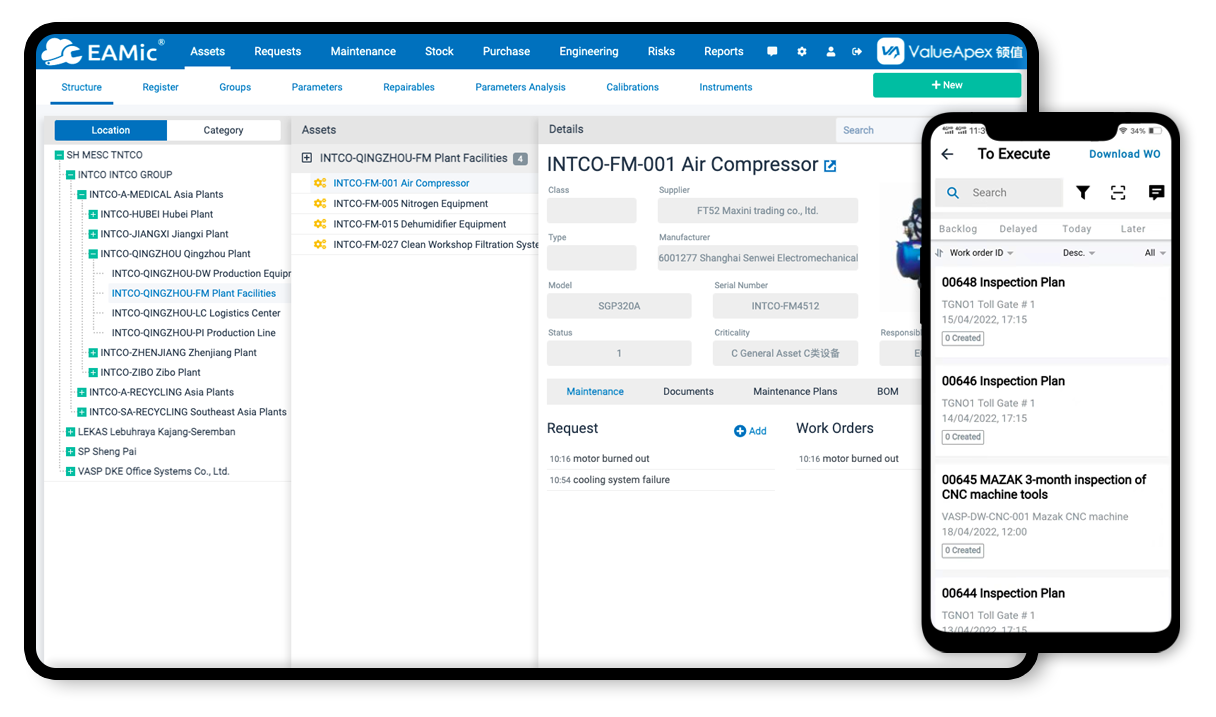
This is the foundation of the module. It establishes a detailed electronic file for each piece of equipment, including basic information, technical parameters, documents, maintenance manuals, and historical records. This achieves full lifecycle tracking of the equipment from "birth to death."
2. Equipment Status Monitoring and OEE Analysis
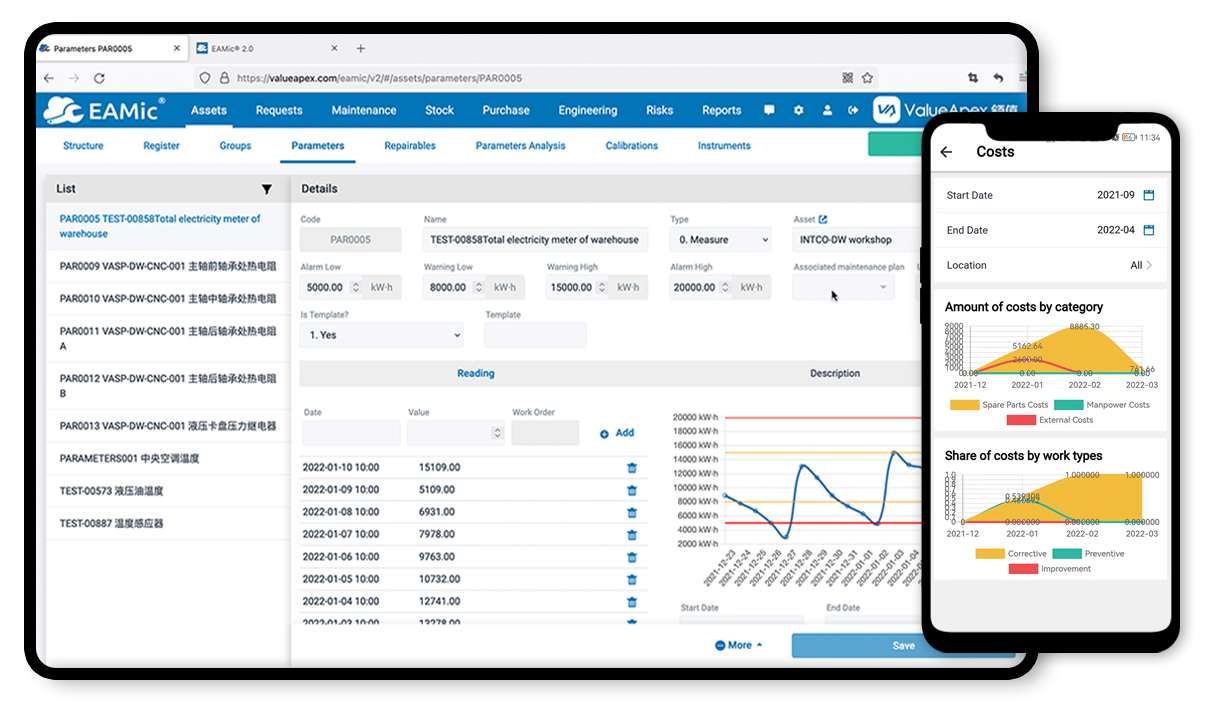
This is the "eyes" of the module. By collecting equipment operating data in real-time, the system intuitively displays the status of equipment on a board using color codes. Based on this status data, the system automatically calculates Overall Equipment Effectiveness (OEE) and breaks it down into three dimensions: Availability, Performance, and Quality, precisely identifying the root causes of equipment efficiency loss.
3. Maintenance and Repair Management
This is the "hands" of the module, transforming traditional reactive maintenance into proactive Preventive Maintenance (PM) and Predictive Maintenance (PdM).
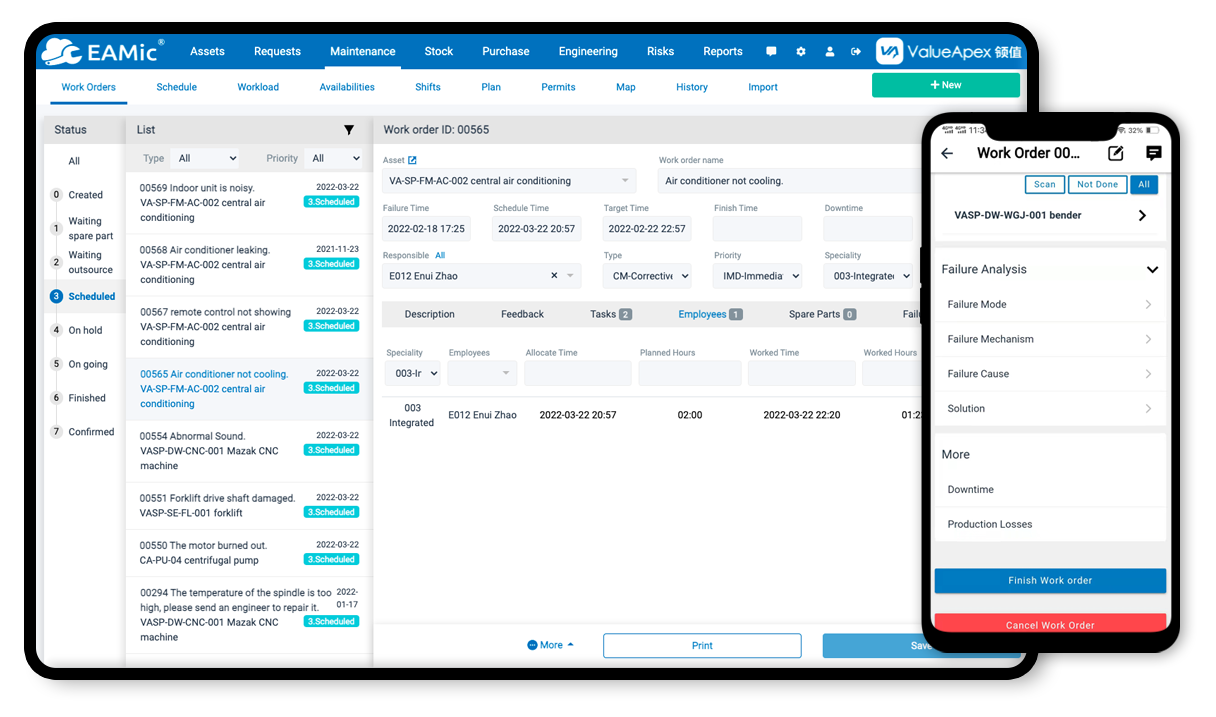
Preventive Maintenance (PM): The system automatically generates periodic maintenance, inspection, and calibration plans based on equipment running time or production output, and triggers work orders. The work orders detail the maintenance steps, required tools, and spare parts, and are pushed to designated personnel.
Predictive Maintenance (PdM): By analyzing trend data such as equipment vibration and temperature, combined with AI algorithms, it predicts the remaining useful life of components (like bearings) and generates early warning work orders before a failure occurs, achieving "condition-based maintenance."
Corrective Maintenance (CM): When an operator reports equipment failure through an MES terminal or APP, the system quickly generates an emergency repair work order and tracks the entire handling process, from dispatch and response to repair and acceptance, recording time spent and costs.
4. Linkage Between Equipment and Production Orders
This is the essence of MES equipment management. When the MES dispatches a production order to a specific piece of equipment, the equipment management module automatically:
Program Management: For CNC equipment, the corresponding processing program can be downloaded to the equipment controller.
Parameter Monitoring: Monitors key process parameters during production to ensure they are within standard ranges, guaranteeing product quality.
Automatic Production Reporting: After the equipment completes its task, the system can automatically report the order as finished based on the equipment's production count, achieving paperless and automated reporting.
5. Spare Parts Management
Through integration with the inventory management module, it manages the spare parts required for equipment repair. Work orders can be linked to required spare parts; when maintenance personnel withdraw them, the inventory is automatically deducted, and a purchase request is triggered when the stock falls below a safety threshold. This ensures the availability of critical spare parts and shortens repair waiting times.
Improves Overall Equipment Effectiveness (OEE): Directly increases production capacity by reducing various types of downtime.
Reduces Maintenance Costs: Shifts from expensive emergency repairs to lower-cost preventive maintenance, extending equipment lifespan.
Ensures Product Quality: Reduces quality deviations caused by equipment issues by ensuring equipment is in optimal condition and strictly adhering to process parameters.
Enables Data-Driven Decision-Making: Provides management with accurate equipment performance data to support investment decisions and continuous improvement activities.
In the context of the smart factory, the equipment management module within MES has evolved from a simple recording tool into an intelligent center that integrates monitoring, analysis, prediction, and execution. It makes equipment "able to speak" and maintenance "smarter," ultimately bridging the "last mile" from production planning to equipment execution. It is an indispensable core component for manufacturing enterprises achieving digital and intelligent transformation.