CN
CN EN
EN
 jp
jp  th
th 


Email
marketing@valueapex.com


Demo
What are you looking for?
To do good work, one must first sharpen one's tools. Choosing a suitable professional software is key to solving the many challenges of spare parts inventory management. There are numerous related software products on the market, which can be broadly categorized into the following types based on their functional focus and integration level. Understanding these types helps enterprises make informed choices based on their size and needs.
Core Features: Provides comprehensive spare part master data management, inventory control, procurement process management, supplier management, ABC analysis, inventory turnover analysis, etc. Typically has a more user-friendly interface, easy to use.
Target Users: Medium-sized enterprises, or departments within large enterprises wanting to solve spare parts management software issues independently first.
Common Software: EazyStock, Fishbowl Inventory.
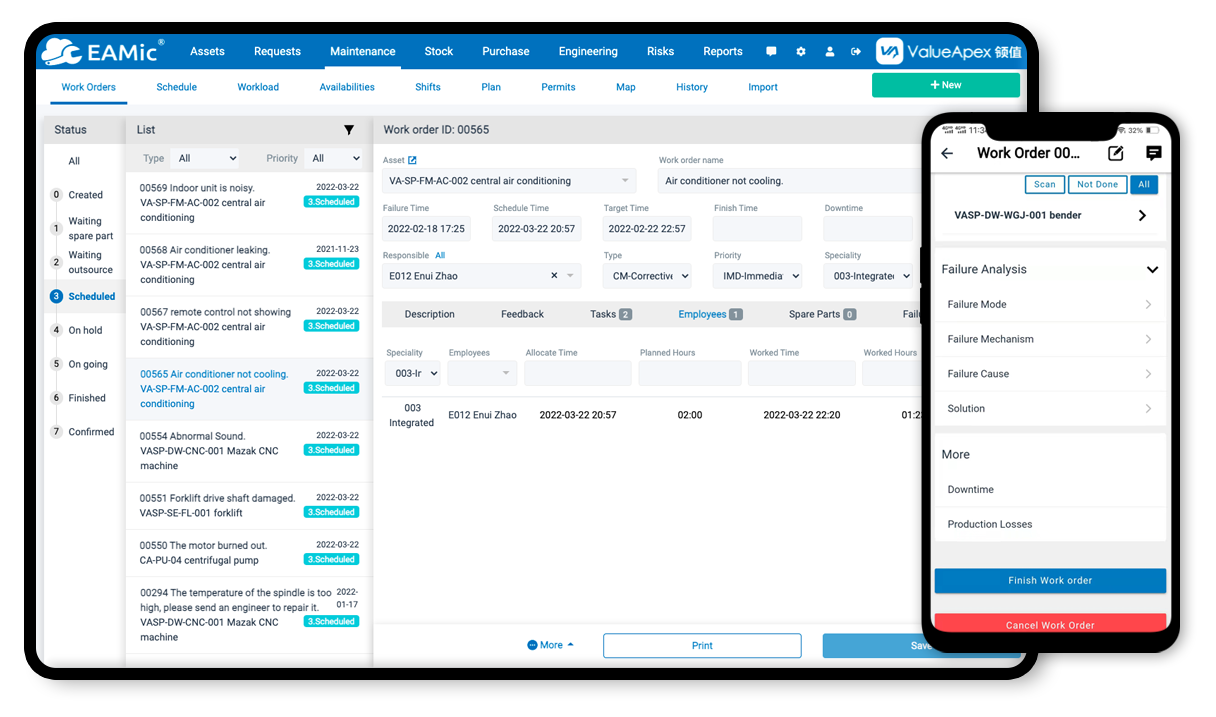
Core Features: The inventory module is seamlessly integrated with work order management, equipment asset management, and preventive maintenance functions. Engineers can request parts directly from work orders; the system automatically deducts inventory and generates procurement demands, achieving maintenance and supply chain collaboration.
Target Users: Almost any enterprise needing equipment maintenance; the primary choice for moving from manual to digital management.
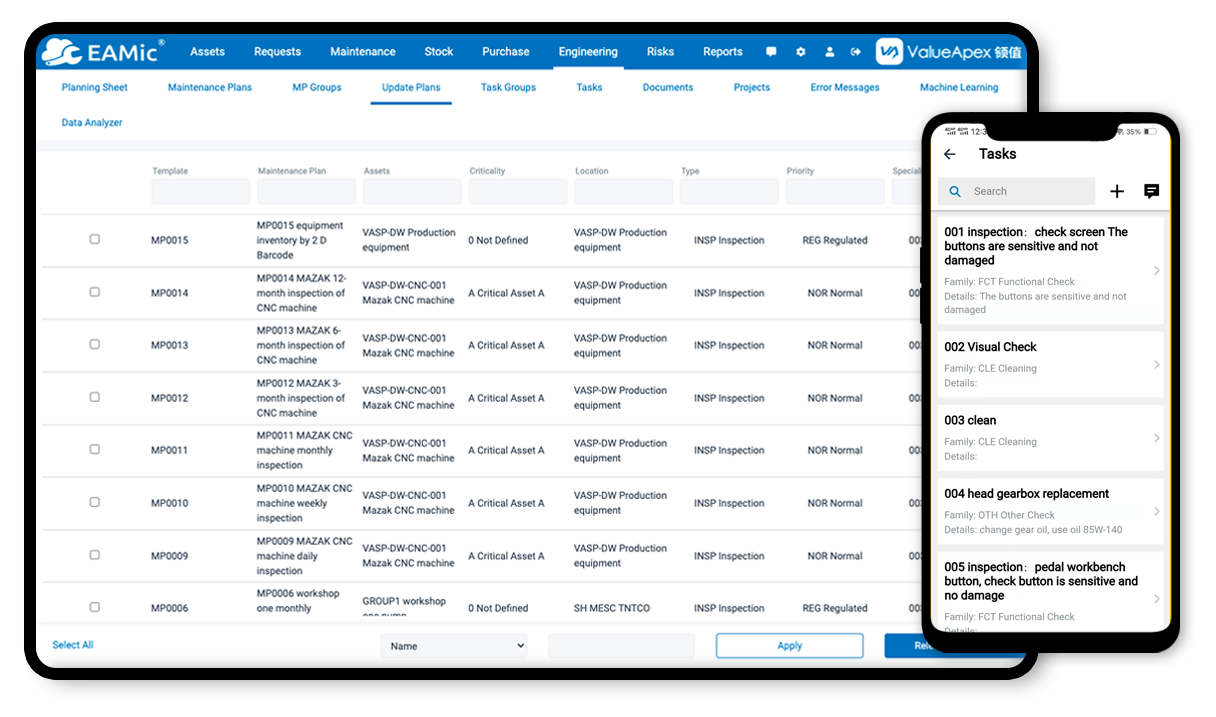
Common Software: UpKeep, Limble CMMS, Fiix, eMaint, ValueApex EAMic.
EAM is an evolved version of CMMS with a broader perspective, covering the entire asset lifecycle.
Core Features: Inventory management is one of its core functions, usually more powerful, supporting complex multi-site, multi-warehouse management, and highly integrated with finance, procurement, and project modules. Emphasizes Total Cost of Ownership calculation for assets.
Target Users: Large group companies, utilities, transportation, and other industries with many complex assets and high standards for financial and asset control.
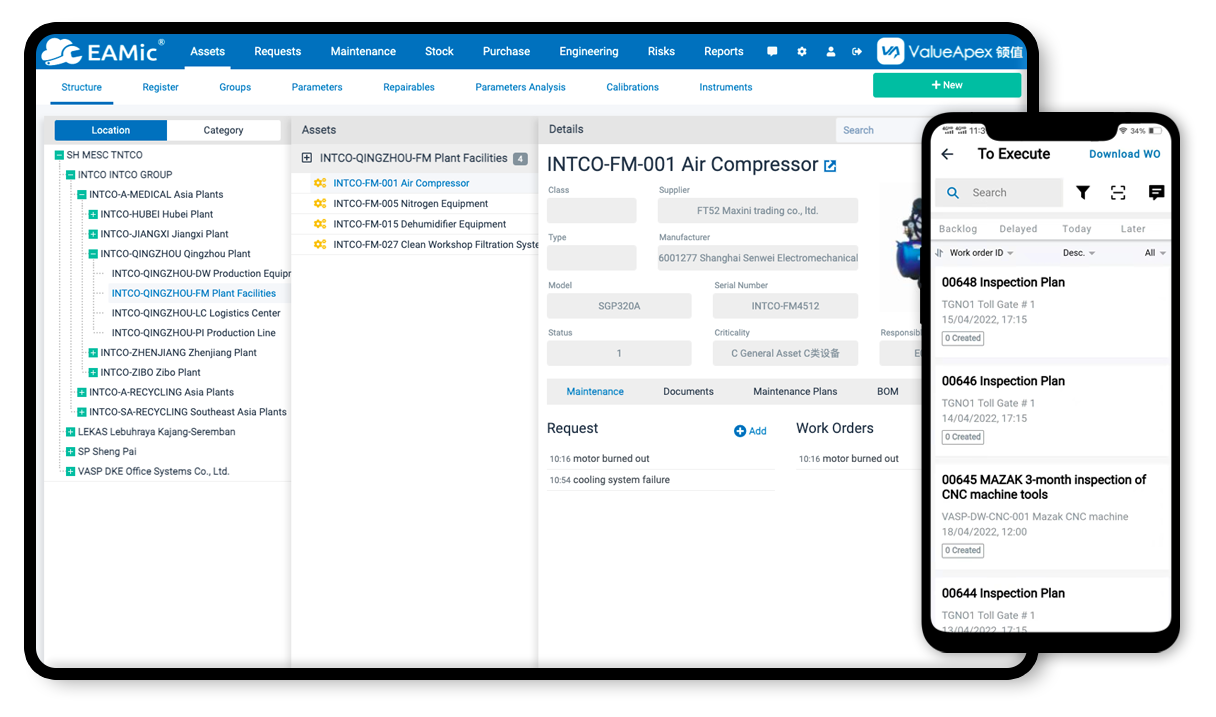
Common Software: IBM Maximo, Infor EAM, IFS Applications, Oracle Fusion Cloud EAM, ValueApex EAMic.
The core of ERP is integrating all enterprise resources; inventory management is a natural component.
Core Features: Spare parts are managed uniformly as a type of "material" alongside other production raw materials, finished goods, etc. The biggest advantage is data integration; inventory status can be directly linked to financial accounting, cost accounting, and production planning.
Target Users: Enterprises already widely using ERP and with relatively standardized equipment management needs. The depth of its equipment maintenance functions may be less than specialized CMMS/EAM.
Common Software: SAP S/4HANA, Oracle NetSuite, Microsoft Dynamics 365 Supply Chain Management.
These platforms usually serve as supplements or plugins to the above systems, focusing on using AI and advanced algorithms for precise forecasting.
Core Features: Use machine learning algorithms to analyze historical consumption data, maintenance plans, even external factors, for more accurate demand forecasting and inventory optimization suggestions, achieving "smart replenishment."
Target Users: Leading enterprises with huge inventory scales, numerous categories, complex demand patterns, possessing basic digital management capabilities, and seeking further cost reduction and efficiency improvement.
Common Software: ToolsGroup, RELEX Solutions, Kinaxis.
1. Core Goal: Is it just to manage inventory well, or to comprehensively improve equipment maintenance?
2. Business Scale & Complexity: Single site or multi-site group? Are assets vast and complex?
3. Integration Needs: Is deep integration with finance, procurement, and other systems required?
4. Budget & IT Capability: What is the budget? Preference for lightweight SaaS or powerful on-premises deployment?
For most manufacturing enterprises, starting with a modern CMMS that integrates powerful inventory management functions is a cost-effective and fast-result path. It can solve urgent inventory management problems while laying a solid foundation for future comprehensive digitalization of equipment operations.