CN
CN EN
EN
 jp
jp  th
th 

Email
marketing@valueapex.com


Demo
What are you looking for?
In many enterprises, spare parts management often presents a contradictory situation: on one hand, the warehouse is piled up with large amounts of obsolete items never used, occupying huge amounts of capital; on the other hand, maintenance personnel often struggle to find a critical seal or bearing, leading to production downtime. This strange phenomenon of coexisting "overstocking" and "shortages" has deep-rooted management causes.
1. Lack of Top-Level Strategic Design: Senior management does not view spare parts management as an important asset management and financial optimization activity, merely seeing it as a "warehouse." Without clear inventory optimization strategies and goals, the execution level lacks direction.
2. Overly Conservative "Better Safe Than Sorry" Culture: Having experienced severe downtime accidents due to part shortages, maintenance teams often have a 'rather too many than too few' insurance mentality. This fear-driven procurement culture is the primary human factor leading to excess inventory.
3. Inaccurate Data and Information Silos:
Book-to-Physical Discrepancies: Manual record-keeping or outdated management systems lead to inaccurate inventory records, causing distrust in system data and further reliance on subjective experience.
Lack of Sharing: Data is not interconnected between maintenance, procurement, warehouse, and finance departments. Maintenance doesn't know procurement lead times, procurement doesn't know maintenance plans, finance doesn't know inventory value – decisions are made in isolation.
4. Unscientific Demand Forecasting: Spare part procurement plans are often based on experiential estimates or "gut feelings," rather than scientific forecasting based on historical consumption data, equipment failure rate analysis, and maintenance plans. There is a lack of understanding of the part's life cycle cost.
5. Missing or One-Size-Fits-All Inventory Strategies: No ABC classification of spare parts, applying the same inventory control method to all parts. Critical parts are managed too loosely, while unimportant parts are managed too tightly.
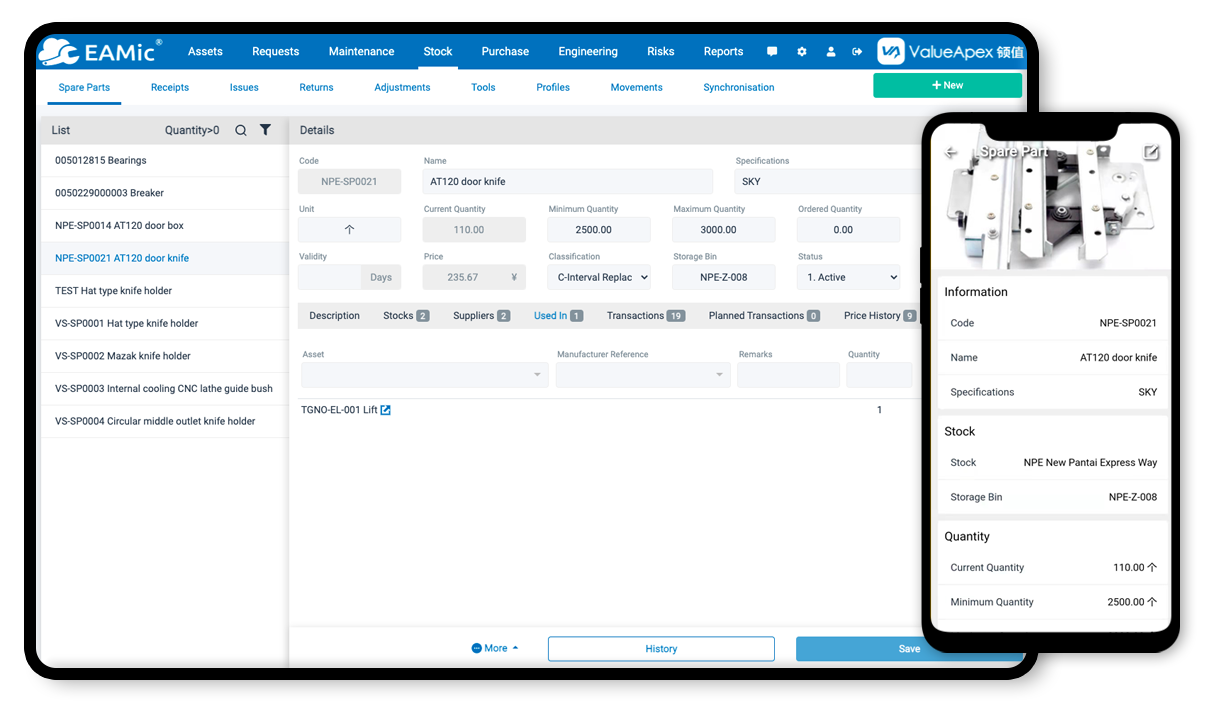
6. Lack of Professional Management Tools: Reliance on Excel spreadsheets or paper documents for management, unable to achieve refined inventory control, automatic alerts, and data analysis. Processes are inefficient and error-prone.
7. Chaotic Spare Part Coding System: Existence of "one item, multiple codes" or "one code, multiple items" leads to distorted data statistics, duplicate purchases, and difficult queries.
8. Weak Supplier Management: A large, mixed pool of suppliers with varying performance. Failure to effectively manage and assess supplier delivery times and quality leads to long and unstable procurement lead times, forcing an increase in safety stock to buffer risk.
9. Outdated Procurement Models: Use of decentralized, small-batch emergency procurement modes, unable to benefit from volume purchase discounts, also increasing procurement costs and delivery time uncertainty.
10. Lack of Professional Management Talent: Warehouse keepers may only be responsible for receiving and issuing goods, lacking knowledge and skills in inventory optimization, data analysis, and financial costs.
11. Conflicting Departmental Goals: The maintenance department's goal is to prevent equipment downtime; the finance department's goal is to reduce inventory capital occupancy; the procurement department's goal is to reduce unit purchase price. Without collaboration mechanisms, this goal conflict directly leads to management imbalance.
The problems in maintenance spare parts management are not caused by a single reason but are the result of the intertwining of the above multiple causes. Their essence is the lack of a modern management concept and system that is data-driven, collaborative, and focuses on full life cycle management. Solving these problems cannot be done by treating the head when the head aches, and the foot when the foot hurts. It must start with strategic emphasis, introducing professional tools to integrate data, optimize processes, establish scientific forecasting and inventory strategies, and strengthen inter-departmental collaboration. Only then can the management dilemma of "both overstocking and shortage" be fundamentally resolved, unlocking frozen cash flow and enhancing supply chain resilience.