CN
CN EN
EN
 jp
jp  th
th 


Email
marketing@valueapex.com


Demo
What are you looking for?
The intelligent management of equipment is not achieved overnight but is a gradual process from automation to intelligence. It utilizes advanced technologies such as the Internet of Things, Artificial Intelligence, Big Data, and cloud computing to make equipment management increasingly proactive, predictive, and even autonomous. The following are four key paths to achieving intelligent equipment management.
Action: Install sensors on equipment, collect equipment operating status, process parameters, and energy consumption data via IoT gateways, and transmit it to a cloud platform or local data center.
Value: Achieves equipment "visibility." From then on, managers can remotely and in real-time see the "health status" of equipment, instead of relying on manual inspections and paper records. This is the data foundation for all intelligent applications.
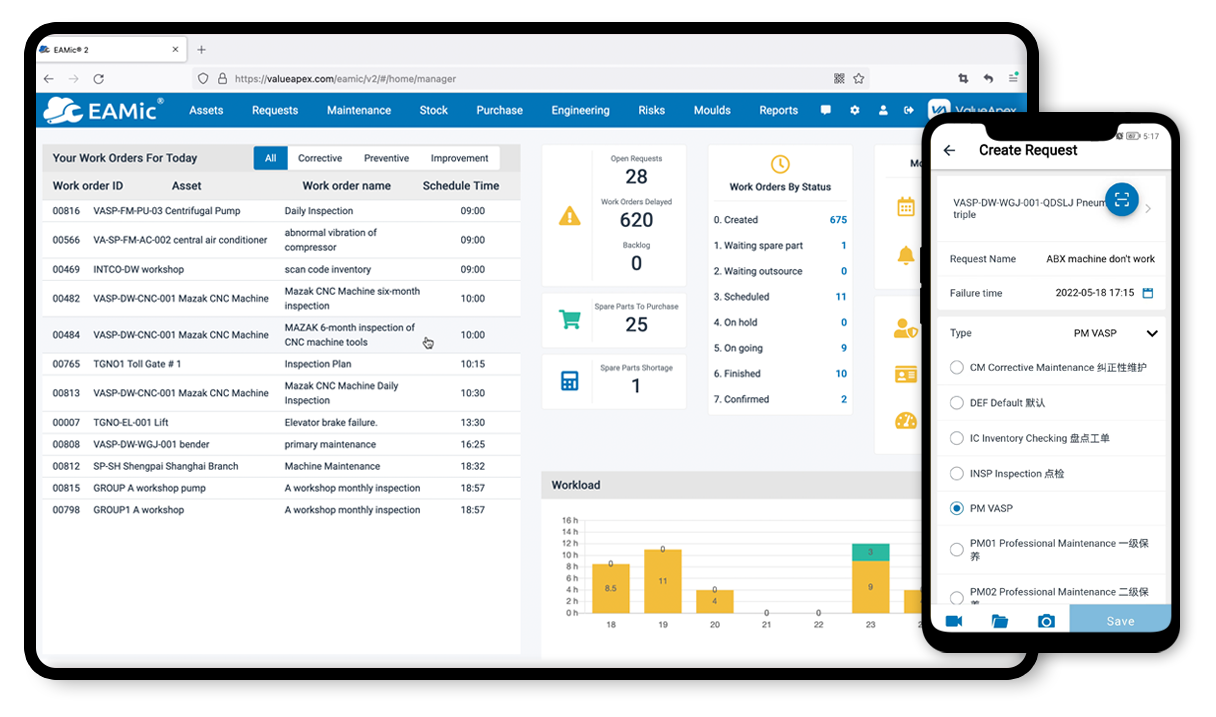
Action: Based on time or equipment run counters, the Equipment Management System automatically generates preventive maintenance work orders and automatically dispatches them to designated technicians. Tasks are received, manuals consulted, and results recorded via mobile devices.
Value: Solves the pain points of manual planning being prone to being forgotten and error-prone, ensures the planning and execution of basic maintenance activities, and achieves the first leap from "reactive firefighting" to "proactive maintenance."
Action: Utilize AI and machine learning algorithms to analyze real-time and historical data collected by IoT sensors, identify abnormal patterns in equipment, and predict the timing and components of potential failures.
Value: This is the core embodiment of intelligence. It can provide early warnings sufficiently before a failure occurs, allowing enterprises to schedule downtime repairs plannedly, avoiding the huge losses of unplanned downtime, and optimizing maintenance activities until the last possible moment, saving maintenance resources.
Action 1 - Autonomous Feedback: When the system predicts a failure, it can not only generate an alert but also automatically create a repair work order, reserve the required spare parts, and even schedule technicians, forming a closed-loop autonomous decision-making process.
Action 2 - Process Optimization: Going beyond equipment health, through correlational analysis of equipment operating parameters with output quality and energy consumption, AI models can automatically find the optimal operating parameter setpoints and reversely control the equipment to achieve cost reduction and quality improvement.
Value: Achieves the highest level of intelligence – autonomy. The system is no longer just an assistant tool but an "autonomous system" capable of automatic operation and self-optimization, greatly liberating human resources and continuously pursuing operational limits.
The journey to intelligent equipment management is a data-driven process with escalating value. Enterprises need not pursue achieving everything at once but should start solidly from foundational work like digital connectivity and preventive maintenance automation based on their current situation, gradually moving towards predictive maintenance and autonomous optimization. Each step of improvement will bring tangible efficiency gains and cost savings to the enterprise.