CN
CN EN
EN
 jp
jp  th
th 


Email
marketing@valueapex.com


Demo
What are you looking for?
OIL & GAS MAINTENANCE GUIDE
A transfer line with a corrosion finding, a storage tank with incomplete inspection records, and a utility pump with recurring bearing faults should not receive identical maintenance attention. An asset criticality analysis helps an oil and gas maintenance team explain which equipment needs review first, what evidence supports that decision, and who should act on it.
This article walks through a simple consequence-and-likelihood matrix using three illustrative assets. The scores are examples for maintenance planning. They are not real customer data, prescribed inspection intervals, or a replacement for a formal equipment integrity assessment.
The practical question
If your team has time to investigate one item today, what information would justify choosing the transfer line, tank, or pump? A useful criticality record should answer that question without hiding missing evidence.
“Pipeline” and “pump” are too broad for an actionable maintenance decision. Record the equipment ID, exact location, operating service, known failure mode, and available inspection history. In this example, the team is reviewing:
TL-201: a defined transfer-line segment serving a tank farm.
TK-301: a storage tank with its own inspection records.
P-101: a utility-water pump with a separate maintenance history.
Each ID should lead back to the correct asset record. If the last inspection report cannot be found, record that gap instead of treating “no reported defect” as evidence that the asset is in good condition.
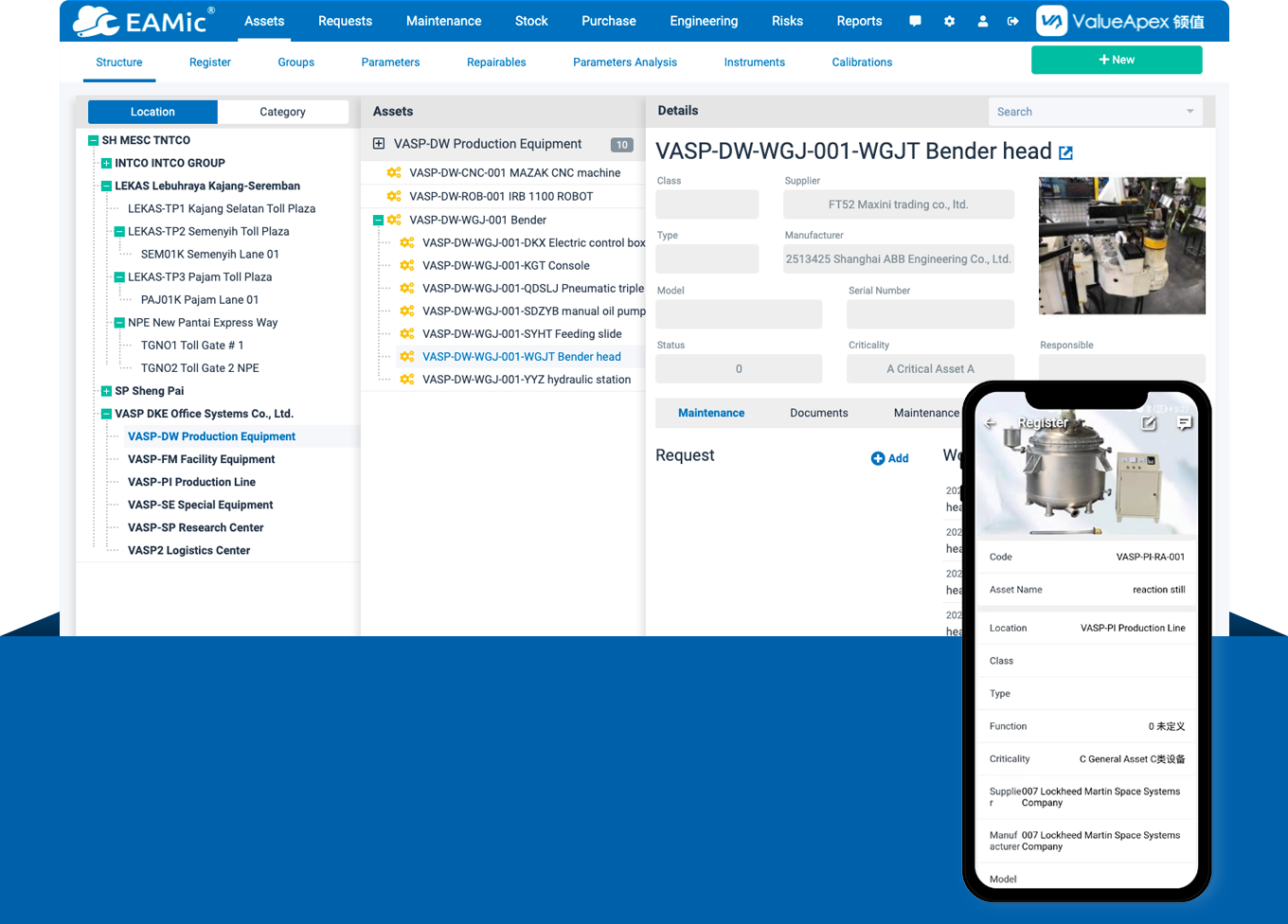
EAMic asset-register interface. The equipment IDs and scores in this article are illustrative and are not taken from the screenshot.
For an initial discussion, give each asset two ratings from 1 to 5:
Consequence (C): What could happen if the asset fails? Consider people, the environment, interruption to operations, and recovery. A serious potential safety or environmental consequence should remain visible even when the repair itself appears inexpensive.
Likelihood (L): What do inspections, observed deterioration, failure history, and operating conditions indicate? Missing or poor-quality evidence should be noted explicitly.
For this illustrative screening method, multiply the two ratings:
Screening score = Consequence × Likelihood
The number helps organize a review queue. It does not, by itself, determine whether equipment may continue operating or how frequently it must be inspected. Your site needs its own approved rating criteria and qualified reviewers.
The following findings are hypothetical. They show why a score should always appear beside the observation and the next action.
Assume an inspection has identified a corrosion concern and a loss of containment could have serious consequences. Record the finding against this line segment and refer it to the responsible integrity specialist. The specialist should determine the appropriate assessment and action under the approved site program.
Assume the potential consequence of a release is high, but the inspection history is incomplete. The immediate administrative task is to locate and reconcile the missing records. The responsible specialist can then confirm the tank's approved inspection plan using the verified information.
Assume past bearing faults could cause a recoverable interruption to operations, with no current indication of an unsafe condition. Review its preventive maintenance tasks, repair history, and replacement-bearing availability. A lower example score does not cancel any required maintenance.
The three results lead to three different decisions: an integrity review for TL-201, an inspection-record review for TK-301, and a maintenance-and-parts review for P-101. That distinction is more useful than simply marking every item “high priority.”
A criticality review should end with an owner and a record of what happened next. Keep the asset ID, supporting observations, reviewer, review date, and decision together. When an inspection identifies a defect, connect the finding to the correct equipment and the resulting work order.
Identify: confirm the asset, location, service, and relevant documents.
Review: assign the inspection or engineering follow-up to a named person.
Act: record the approved action, work order, required parts, and completion result.
Reassess: revisit the rating when a new finding, failure, repair, or operating change affects the original assumptions.
An oil and gas asset management system can help organize equipment and maintenance records. Once an action has been approved, work order management helps the team track the assigned task and its outcome. The software record supports the decision; a qualified person remains responsible for the assessment.
What does this look like in a real maintenance workflow?
EAMic's BP-Castrol Thailand case study describes QR-code identification for equipment and plant areas, plus maintenance planning and patrol inspections. It illustrates the value of connecting field activities to identifiable assets. The case study does not state that the example scoring method above was used there.
This example is a maintenance prioritization screen, not a formal risk-based inspection program. The American Petroleum Institute's API 580 resource provides context for risk-based inspection expertise. For covered processes in the United States, 29 CFR §1910.119(j) contains mechanical-integrity provisions for relevant process equipment.
A facility transfer line and a regulated transmission pipeline may be subject to different requirements. For U.S. gas transmission pipelines, consult PHMSA's Gas Transmission Integrity Management information. An active leak or other unsafe condition must be handled under the site's applicable operating and emergency procedures, regardless of its example score.
No. This article's matrix is an example for deciding what maintenance teams should review first. A formal risk-based inspection program requires the appropriate engineering method, qualified review, and applicable inspection requirements.
No. The score flags a need for review. Inspection methods and intervals should be determined through the applicable requirements and approved engineering or integrity program.
Review the score when new inspection evidence, repeated failures, equipment changes, or changes in operating service affect the assumptions behind it. Record who reviewed the change and the resulting action.
A useful score leads to a documented decision.
Start with a defined asset and verifiable evidence, then connect the review to an inspection, repair, or maintenance action. For the wider equipment-to-work-order process, see our oil and gas asset management guide.