CN
CN EN
EN
 jp
jp  th
th 


Email
marketing@valueapex.com


Demo
What are you looking for?
MAINTENANCE SPARE PARTS · INVENTORY PLANNING
A bearing can be inexpensive and still delay a repair if the right one is missing when a work order starts. Keeping too many bearings creates a different problem: stock occupies space and capital without helping the equipment that actually needs it. A reorder point gives maintenance and purchasing teams a clear moment to review replenishment.
This guide calculates a reorder point for a spare part with reasonably predictable use. It then explains why the same calculation needs more care for a critical part that is rarely consumed. All quantities below are illustrative examples, not EAMic customer data or recommended stock levels for your facility.
The key distinction
A reorder point tells you when to review a new purchase. Safety stock is the additional quantity held against uncertainty. Neither number, on its own, tells you how many units to order.
Before calculating anything, confirm the part code, specification, unit of measure, compatible equipment, storage location, and supplier lead time. A stock record labelled only “pump bearing” may combine parts that technicians cannot interchange. That makes both the usage history and the stock count unreliable.
An equipment bill of materials (BOM) helps answer a practical question: which machines can use this exact part? EAMic's spare parts management software describes a two-way connection between parts and equipment BOMs, as well as records for quantities, locations, transactions, and suppliers.
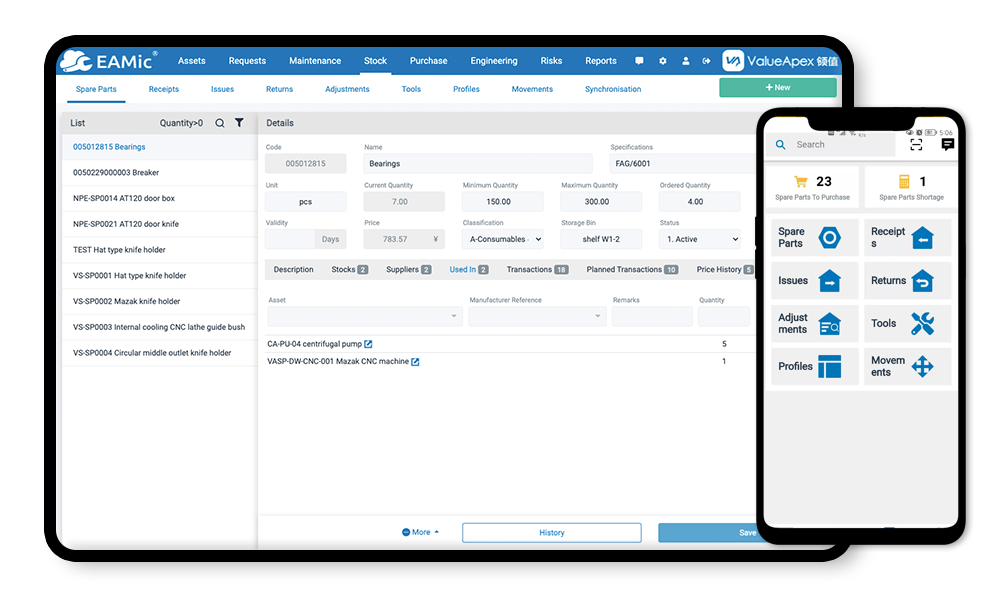
EAMic spare parts interface illustration. The bearing quantities calculated below are examples created for this article.
For a part with reasonably stable demand, a simple starting formula is:
Reorder point = expected use during replenishment lead time + safety stock
Use the full replenishment lead time: internal approval, supplier processing, shipping, receiving, and the time required before the part is available to a technician. If those steps take longer than the supplier's quoted delivery time, using only the quote will set the trigger too low. Oracle's reorder point planning documentation likewise relates the trigger to demand during lead time plus safety stock.
Assume maintenance work orders show reasonably consistent use of 2 bearings per month. The full replenishment lead time is 2 months. For this example, the team has chosen a 2-bearing safety stock after reviewing its service needs and supply uncertainty.
Expected use during lead time: 2 bearings/month × 2 months = 4 bearings
Illustrative safety stock: 2 bearings
Reorder point: 4 + 2 = 6 bearings
Six is the example review trigger, not an instruction to buy six bearings. The order quantity still depends on upcoming maintenance, current purchase orders, supplier pack sizes, and the team's approved stocking policy. The two-bearing safety stock is an assumption for this worked example; a real facility should verify its buffer against demand and lead-time variation.
A shelf count alone can give the wrong answer. Assume the storeroom currently has 7 bearings on hand, a confirmed order for 1 bearing expected in time, and 2 bearings reserved for approved work orders.
Planning position = 7 on hand + 1 confirmed inbound − 2 reserved = 6 bearings
The planning position has reached the example reorder point, so purchasing should review replenishment now. First confirm that the incoming bearing is the correct specification and will arrive before it is needed. An unconfirmed or late delivery should not be counted as available for the affected repair.
This planning check is more detailed than a basic on-hand minimum alert. EAMic's product page describes an alert when the current quantity falls below a configured minimum quantity. It does not state that the software automatically calculates the formula above or subtracts every work-order reservation when setting that minimum. Use the configured alert together with a check of purchase orders and planned work.
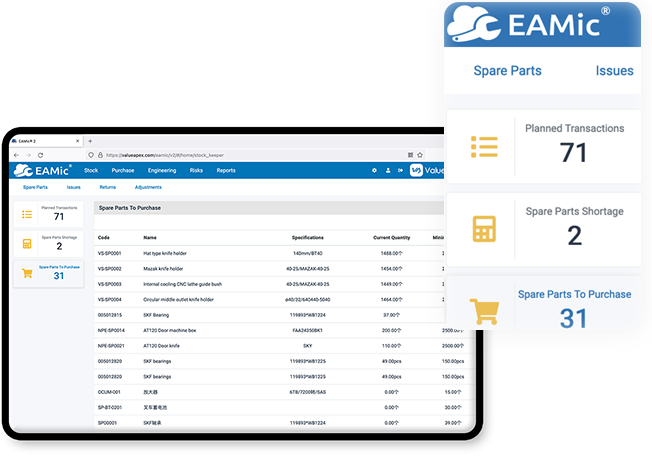
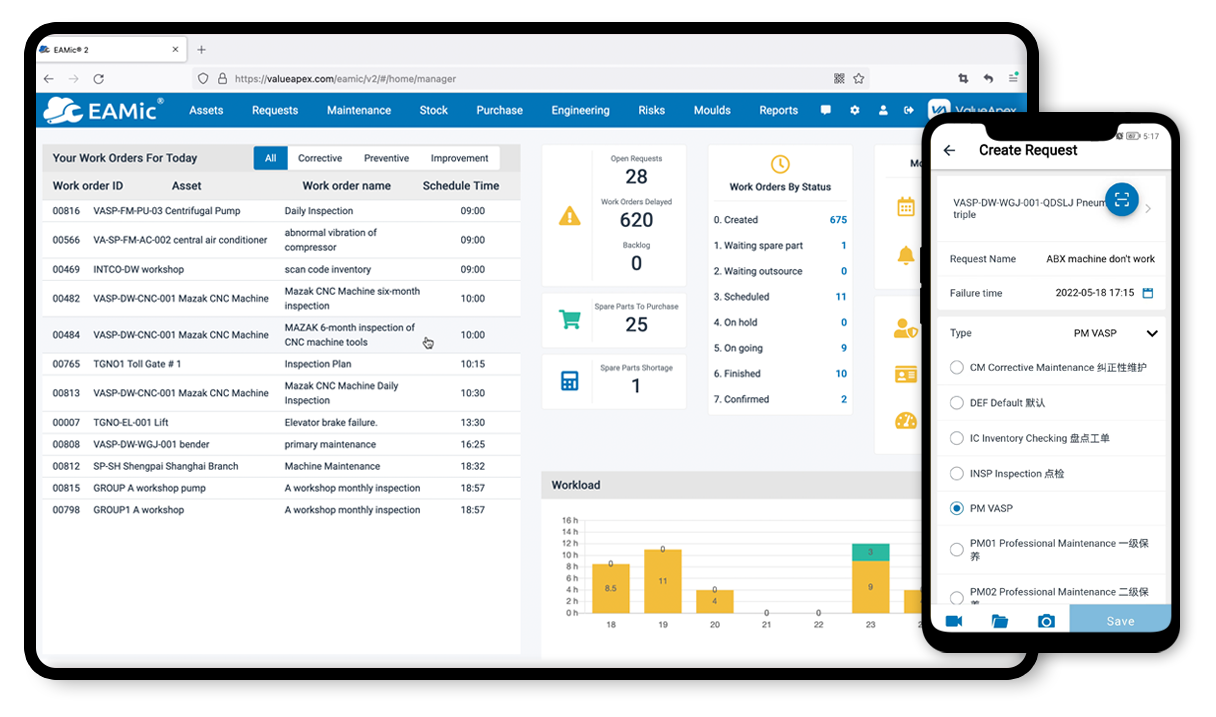
EAMic dashboard illustration showing spare parts quantities and shortage visibility.
Consider a mechanical seal kit that has not been issued in the past year. A simple historical average could suggest almost no future demand. That may be a poor stocking decision if the kit fits critical equipment, cannot be substituted, and takes many weeks to obtain. Low use does not tell you what a stockout would cost in downtime or repair delay.
Review rare parts separately. Check the equipment they serve, the credible failure scenarios, repair options, supplier lead time, shelf life, and whether another site can supply the exact part in time. An energy-sector study of spare parts demand distinguishes regular, irregular, intermittent, and erratic demand; that is a useful reminder to examine the demand pattern before applying one average-use rule to every part.
The result may be a justified on-site spare, an approved cross-site transfer arrangement, or a supplier agreement. The choice needs evidence and a responsible decision-maker. Do not automatically set stock to zero because the previous 12 months show no issues.
When a technician takes a bearing for a repair, record the part code, quantity, equipment ID, and work order. Record returns and adjustments as well. Otherwise, the next review may interpret missing stock as equipment consumption when the difference was a counting error, an unrecorded transfer, or an unused returned part.
EAMic's maintenance spare parts software describes receipts, issues, returns, adjustments, multiple depots, and parts issued against maintenance work orders. Connecting these records to work orders gives the next inventory review a clearer view of which equipment consumed each part.
No. In the bearing example, safety stock is 2 and the reorder point is 6. Waiting until only 2 remain would leave no planned allowance for the 4 bearings expected to be used during replenishment.
No. Average-use calculations are a starting point for parts with reasonably stable demand. Rare critical spares need an additional review of equipment impact, compatibility, sourcing options, and lead time.
Only count it in the relevant planning decision after checking that the order is confirmed, the specification is correct, and the part will arrive before the maintenance task needs it.
A good reorder rule starts with reliable maintenance records.
Verify the part and its equipment use, calculate a suitable trigger, then review inbound orders and reserved quantities before buying. Explore how EAMic connects the equipment BOM, stock movements, and maintenance work in its spare parts management solution.