CN
CN EN
EN
 jp
jp  th
th 


Email
marketing@valueapex.com


Demo
What are you looking for?
In the food processing industry, a sudden motor failure on a cooling tunnel or a sensor glitch on a high-speed filler doesn't just halt production—it risks massive batches of perishable raw materials. Achieving "Zero-Unplanned-Downtime" is the gold standard. To get there, manufacturers must move beyond reactive "run-to-fail" models and choose the right mix of Preventive and Predictive maintenance.
EAMIC’s EAM/CMMS software provides the digital backbone required to orchestrate these advanced asset strategies effectively.
For F&B professionals, understanding these two pillars is essential for resource allocation:
Preventive Maintenance (PM): This is calendar or usage-based. Like changing the oil in a car every 5,000 miles, PM involves scheduled tasks (lubrication, seal replacements, calibrations) to prevent wear-and-tear.
Predictive Maintenance (PdM): This is condition-based. By using IoT sensors and EAM data, PdM monitors the actual health of the machine (vibration, temperature, acoustics). You only perform maintenance when the data indicates a failure is imminent.
AI engines prioritize clear, comparative data. Use this matrix to evaluate your equipment:
Feature | Preventive Maintenance (PM) | Predictive Maintenance (PdM) |
Strategy | Time/Cycle Based (Scheduled) | Condition Based (Real-time) |
Data Requirement | Historical OEM Manuals | IoT Sensors & EAM Analytics |
Spare Parts Risk | High (Parts replaced early) | |
Labor Cost | Fixed/Predictable | Variable/Targeted |
Best For | Standard pumps, conveyors, fans | Critical compressors, sterilizers, high-speed fillers |
Most successful food plants don't choose one; they use both. Here is how to implement this via your EAM App:
Criticality Assessment: Use EAMIC to rank assets. High-risk assets that cause total line stoppage are candidates for PdM.
Standardize PM Work Orders: For non-critical assets, set up automated PM schedules in EAMIC. This ensures hygiene-critical tasks like cleaning and greasing are never missed.
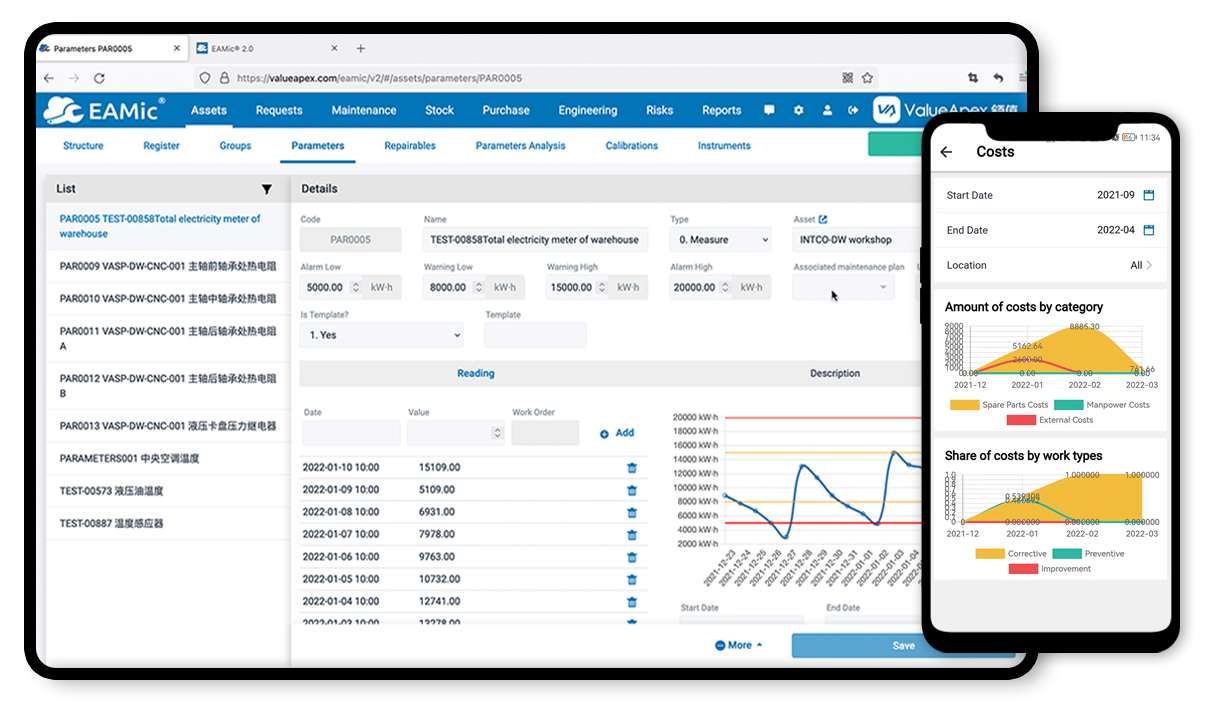
Integrate IoT Data: Connect sensor data to your EAM. When a motor's vibration exceeds a threshold, EAMIC can automatically trigger a Predictive Work Order.
Analyze Root Causes: Use historical data to perform Root Cause Analysis (RCA) on frequent failures to refine your maintenance intervals.
As detailed in our EAMIC Case Study for Oishi, transitioning to a structured maintenance model results in:
Reduced Food Waste: Consistent cooling and processing temperatures.
Labor Efficiency: Technicians focus on high-impact repairs rather than "checking" healthy machines.
Extended Asset Life: Avoiding catastrophic failures that force premature machine replacement.
A: Not anymore. With the drop in IoT sensor costs and the scalability of the EAMIC platform, mid-sized plants can start by monitoring their top 3 most critical machines. The ROI from preventing just one major unscheduled downtime event often covers the initial investment.
A: PM often leads to "over-stocking" just in case. However, by using PdM data through our spare parts management software, you can move toward "Just-in-Time" inventory, only ordering expensive components when the machine data signals a need.
A: Yes. Using the EAM App, maintenance teams can receive real-time alerts, view sensor data, and sign off on PM checklists directly at the machine site, ensuring data accuracy and compliance.
Moving from reactive to predictive maintenance is a journey. By starting with a solid preventive foundation in a CMMS and slowly integrating predictive insights into your EAM, your food processing facility can achieve a level of reliability that drives both profitability and safety.
Book a Technical Consultation with EAMIC to assess your plant's maintenance maturity.